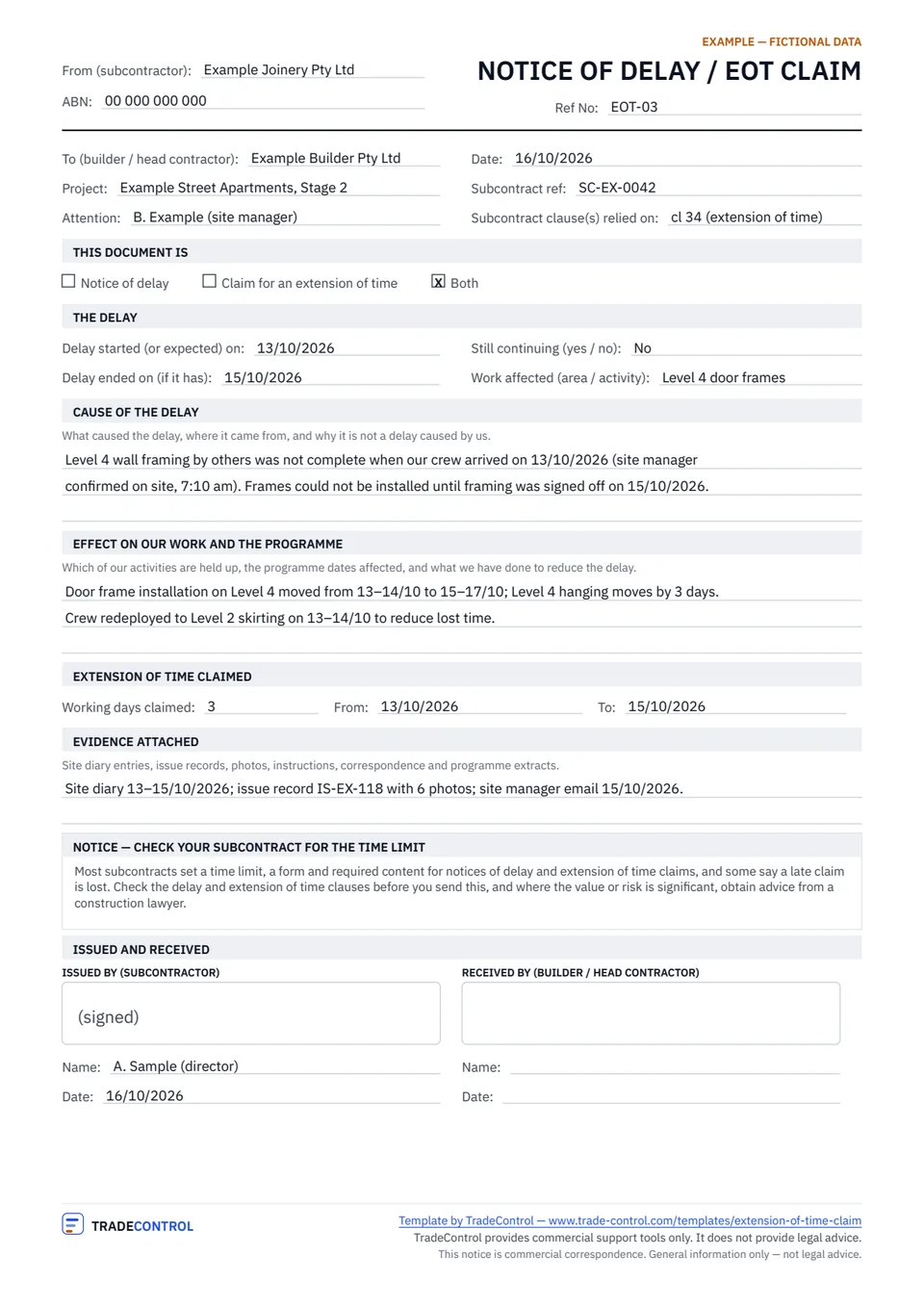
Notice of delay or extension of time claim?
A notice of delay is the early warning: something outside your control is holding up your work, and the builder or head contractor needs to know now. An extension of time claim comes once you can say how many days the delay has cost, and asks for that time to be added to your completion date.
Many subcontracts ask for both, in that order, each within its own time limit. Tick the box at the top of the template to say which one you are sending; tick “Both” when the delay is over and you can give notice and claim the days together.
How to fill it in
- Address it. Your company and ABN, a reference number, the builder or head contractor, the date, the project, the subcontract reference, who it is for, and the subcontract clauses you rely on.
- Say what it is. Notice of delay, claim for an extension of time, or both.
- The delay. When it started (or is expected to), whether it is still going, when it ended, and the area or activity affected.
- Cause and effect. What caused the delay and why it is not one you caused; then which of your activities are held up, the programme dates affected and what you did to reduce the delay.
- Days claimed. The working days claimed and the period they cover.
- Evidence, then sign and send. List what you attach, sign it, send it the way your subcontract requires, and keep a copy with the date it went.
Time limits in your subcontract
Delay notices and extension of time claims are governed by your subcontract. Most subcontracts set a time limit, counted from when you became aware of the delay, and some set a form and the content a notice must include. Some say that a notice or claim given late is lost. Read the delay and extension of time clauses before the work is held up for long, and diary the date the notice is due.
Australian terminology
- Extension of time (EOT). Extra time added to the date for completion of your work.
- Notice of delay. Written notice that a delay has started or is expected, and its cause.
- Qualifying cause of delay. A cause the subcontract says can entitle you to an extension.
- Time bar. A clause that limits or removes a claim if notice is not given within a set time.
- Critical path. The chain of activities that sets the completion date; a delay to one of them moves completion.
What makes it hold up if it is disputed
An extension of time claim is assessed against the record. The claims that hold up are the ones where every day claimed can be matched to a diary entry, an issue logged at the time with photos, and the instruction or event that caused it. Say what you did to reduce the delay, keep the cause separate from any delay of your own, and send the notice when the delay starts rather than at the end of the job.