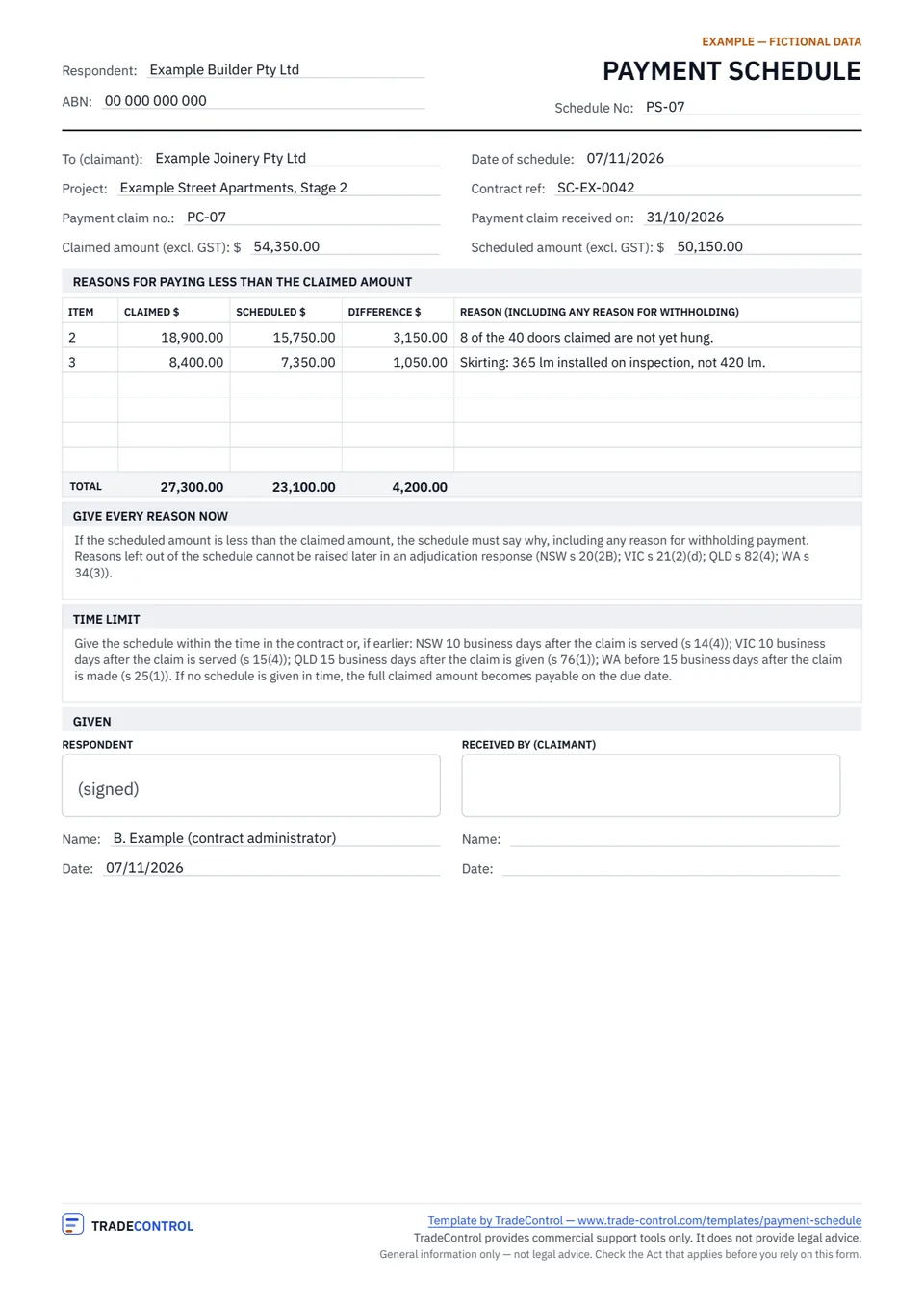
Who gives a payment schedule
The party that receives a payment claim. For a subcontractor that usually means answering the claims of its own subcontractors and suppliers. The same document is what you should expect back from the builder when you serve your own payment claim.
What it must contain
In all four states a payment schedule must identify the payment claim it responds to and state the amount the respondent proposes to pay (the scheduled amount). If that is less than the claimed amount, it must say why, including any reason for withholding payment (NSW s 14(2)–(3); VIC s 15(2)–(3); QLD s 69; WA s 25(2)–(3)).
Time limits by state
- NSW: within the time in the contract or 10 business days after the claim is served, whichever is earlier (s 14(4)).
- Victoria: within the time in the contract or 10 business days after the claim is served, whichever is earlier (s 15(4)). A claim served before its earliest day is treated as served on that day (s 14A(5)).
- Queensland: within the contract period or 15 business days after the claim is given, whichever ends first (s 76(1)); no schedule is needed if the claim is paid in full by the due date (s 76(2)).
- Western Australia: before the earlier of the time in the contract or 15 business days after the claim is made (s 25(1)).
Business days exclude weekends, public holidays and each Act's Christmas period, which differs by state. The Payment Claim Date Calculator counts them for you.
How to fill it in
- Identify the claim. The claimant, the project and contract, the payment claim number and the date you received it.
- State the amounts. The claimed amount and the amount you will pay.
- Explain each difference. One line per item you are paying less on: claimed, scheduled, the difference (the Excel version works it out) and the reason.
- Sign and give it in time. Give it the way your contract or the Act allows and keep proof of the date.
Australian terminology
- Payment schedule. The respondent's written answer to a payment claim under the security of payment Acts.
- Scheduled amount. The amount the respondent proposes to pay.
- Withholding. Keeping back part of a payment, for example for incomplete or defective work or under a set-off; the reason must be in the schedule.
- Claimant and respondent. The party that served the claim, and the party answering it.
What makes it hold up if it is disputed
Reasons that are not in the payment schedule cannot be raised later in an adjudication response (NSW s 20(2B); VIC s 21(2)(d); QLD s 82(4); WA s 34(3)). If you are short-paying because work is incomplete, defective or not done, or because you are withholding an amount, say so in the schedule, item by item, with the evidence you are relying on.
Checked against
- Building and Construction Industry Security of Payment Act 1999 (NSW) — current version for 20 August 2024 to date
- Building and Construction Industry Security of Payment Act 2002 (Vic) — Authorised Version No. 015, incorporating amendments as at 24 June 2026
- Building Industry Fairness (Security of Payment) Act 2017 (Qld) — reprint current as at 28 April 2026
- Building and Construction Industry (Security of Payment) Act 2021 (WA) — compilation 00-e0-00, as at 1 February 2024
Checked on 17 October 2026. Last reviewed October 2026.
Official forms
Linked, not reproduced. Check each regulator's page for the current version.
- WA — recommended payment schedule template: WA Building Commissioner (opens in a new tab)
- VIC — security of payment forms and guidance: Building and Plumbing Commission (opens in a new tab)