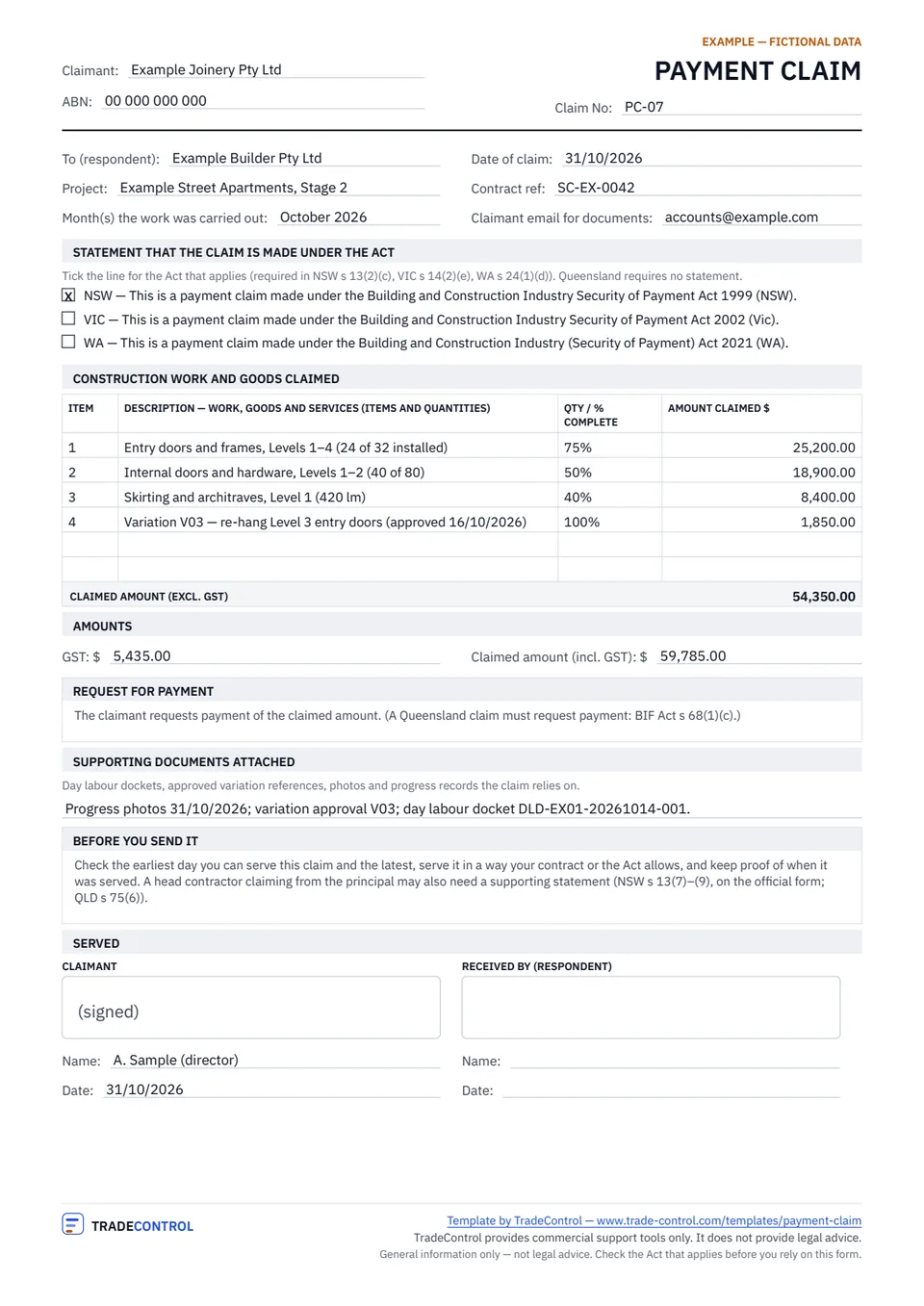
How to fill it in
- Claim details. Your company and ABN, a claim number, the respondent, the date of the claim, the project and contract, the month or months the work was carried out, and the email address you want documents sent to.
- The statement. Tick the statement for the Act that applies to your contract. Queensland needs no statement (see below).
- The work. One line per item of work or goods and services, with the quantity or percentage complete and the amount claimed. Western Australia asks for items and quantities.
- The amounts. The claimed amount excluding GST, the GST and the total. The Excel version totals the lines.
- Supporting documents. List the dockets, approved variation references, photos and progress records you attach.
- Serve it. Sign it, serve it by a method the contract or the Act allows, and keep proof of the date it was served.
Australian terminology
- Payment claim. The security of payment Acts' name for a claim for a progress payment. A progress claim or an invoice can be one if it meets the Act's requirements.
- Claimant and respondent. The party making the claim, and the party it is served on.
- Claimed amount and scheduled amount. What the claim asks for, and what the respondent's payment schedule says it will pay.
- Named month and reference date. The month-based timing for claims in NSW, Victoria and Western Australia, and the date-based timing in Queensland.
- Supporting statement. A head contractor's declaration, served with its own claim, that its subcontractors have been paid.
What makes it hold up if it is disputed
A claim holds up when it meets the Act that applies: the right contents, served on a day the Act allows, no more often than the Act allows, and with proof of service. If a valid claim is not paid in full, the respondent must give a payment schedule on time or become liable for the amount claimed. Each state's rules follow; keep the records behind every line of the claim with it.
NSW
Under the Building and Construction Industry Security of Payment Act 1999 (NSW), a payment claim must identify the construction work (or related goods and services), indicate the amount claimed, and state that it is made under the Act (s 13(2)).
- You can serve a claim on and from the last day of the named month in which the work was first carried out, and on and from the last day of each later month (s 13(1A)), or earlier if the contract allows (s 13(1B)).
- Serve it within the period in the contract or 12 months after the work was last carried out, whichever is later (s 13(4)).
- One claim per named month for work done in that month, unless the contract allows more (s 13(5)).
- A head contractor claiming from the principal must attach a supporting statement in the approved form declaring that its subcontractors have been paid (s 13(7)–(9)).
Victoria
Under the Building and Construction Industry Security of Payment Act 2002 (Vic), as reformed from 15 April 2026, a payment claim must identify the work, state the amount claimed and state that it is made under the Act (s 14(2)).
- You can serve a claim on and from the last day of the named month in which the work was first carried out, and of each later month (s 14A(1)), or earlier if the contract allows (s 14A(3)).
- December rule: for work done between 1 and 21 December, from 22 December; for work done between 22 and 31 December, from 31 January (s 14A(2)).
- A claim served too early is not invalid: it is treated as served on the earliest day it could have been (s 14A(5)).
- The latest day is the day before the latest of the date in the contract, 6 months after practical completion of all the work, or 6 months after the last related supply (s 14C).
- One claim per named month, unless the contract allows more (s 14D).
Queensland
Under the Building Industry Fairness (Security of Payment) Act 2017 (Qld), a payment claim is a written document that identifies the work, states the amount claimed and requests payment (s 68(1)). No statement that it is made under the Act is needed, and a document bearing the word “invoice” satisfies the request for payment (s 68(3)).
- A claim may be made from each reference date: the date in the contract or, if it is silent, the last day of the month in which work was first carried out and of each later month (s 67(1)).
- Give it within the longer of the contract period or 6 months after the work was last carried out; a final claim has its own, longer limit (s 75(2)–(3)).
- One claim per reference date (s 75(4)).
- A head contractor's claim must be accompanied by a supporting statement (s 75(6)).
Western Australia
Under the Building and Construction Industry (Security of Payment) Act 2021 (WA), a payment claim must be in writing, indicate the amount claimed, describe the items and quantities of work (or goods and services) it relates to, and state that it is made under the Act (s 24(1)).
- A claim may be made on or after the last day of the named month in which the work was first carried out, and of each later month (s 23(2)), or earlier if the contract allows (s 23(3)).
- A claim other than the final claim must be made before the later of the date in the contract or 6 months after the work was last carried out; the final claim has a longer limit (s 23(4)–(5)).
- One claim per named month, unless the contract allows more (s 23(7)).
- An invoice can be a payment claim, and it does not need to be signed (s 24(3)–(4)).
Serving the claim
Serve the claim by a method your contract or the Act allows: by hand, by leaving it at the respondent's place of business, by post, or by email where the Act or your contract allows it (in NSW and WA, to an address the respondent has given for documents of that kind). Keep proof of the date it was served. Posted claims take time to count as served: in Victoria, 7 business days after posting unless delivered earlier (s 50(2)(c)); the other states use the ordinary course of post, and NSW's rule is a question for a lawyer (the Payment Claim Date Calculator explains each state).
What happens next
The respondent must give a payment schedule within the time in the contract or, if earlier, 10 business days after the claim is served in NSW (s 14(4)) and Victoria (s 15(4)), and 15 business days in Queensland (s 76(1)) and Western Australia (s 25(1)). If it does not, it becomes liable for the full amount claimed on the due date. Work out the dates for your claim with the Payment Claim Date Calculator, and read the guide for your state for the adjudication windows.
Checked against
- Building and Construction Industry Security of Payment Act 1999 (NSW) — current version for 20 August 2024 to date
- Building and Construction Industry Security of Payment Act 2002 (Vic) — Authorised Version No. 015, incorporating amendments as at 24 June 2026
- Building Industry Fairness (Security of Payment) Act 2017 (Qld) — reprint current as at 28 April 2026
- Building and Construction Industry (Security of Payment) Act 2021 (WA) — compilation 00-e0-00, as at 1 February 2024
Checked on 17 October 2026. Last reviewed October 2026.
Official forms
Linked, not reproduced. Check each regulator's page for the current version.
- NSW — supporting statement (approved form, s 13(9)): Building Commission NSW (opens in a new tab)
- VIC — sample payment claim (SOP-SFM-001): Building and Plumbing Commission (opens in a new tab)
- WA — recommended payment claim template: WA Building Commissioner (opens in a new tab)